






The original version of this article was written by me in 2024 for the ProCopywriters website – you can view it here . It was a ‘how-to’ article aimed at would-be copywriters, but I’ve revised it here to apply to property marketers generally.
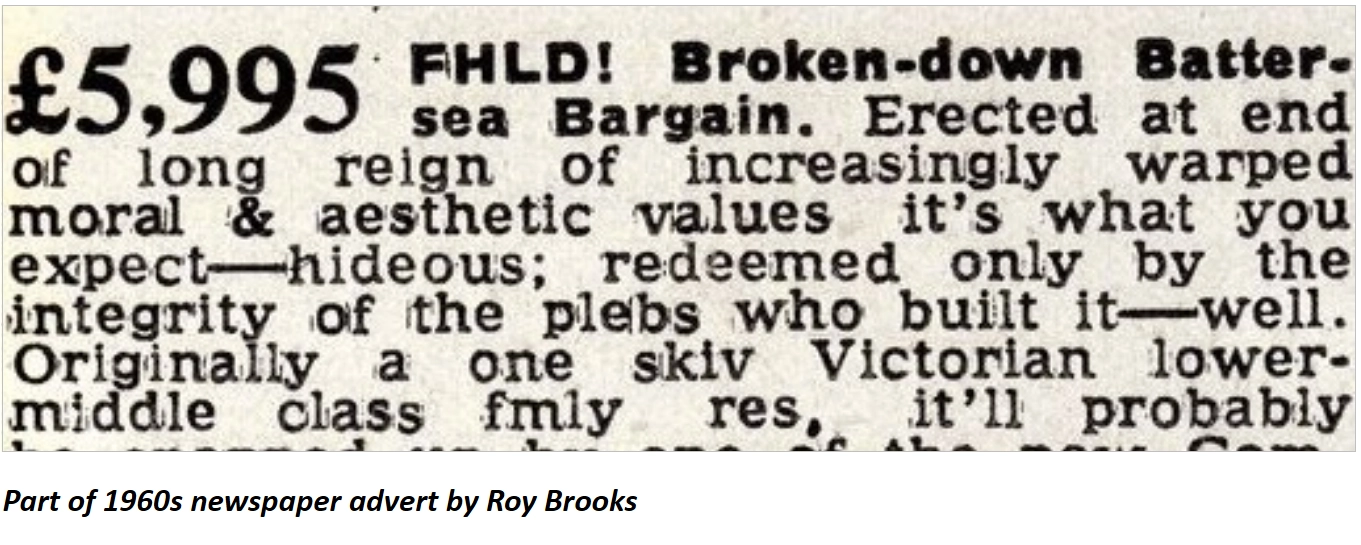
In the 1960s, there was an estate agent in London called Roy Brooks. In an age of boring, repetitive and misleading property ads his approach was rather different. He told the truth, wittily and memorably.
What others would call a bijou flat, Brooks was unafraid to label a broom cupboard. But that was one of his tamer descriptions.
“Will anyone take pity on a nasty old house?’ went one first line, with rooms ‘all in pretty foul order’. Its proximity to London Zoo meant that, “On still nights the friendly howl of the hyaena floats over the Mappin Terraces“.
However, he wasn’t just a self-indulgent oddity, he was highly successful. This was despite the fact that his ads weren’t gleaming magazine spreads or the detailed online showcases of today. They were just a few lines in newspapers, somewhere in the middle of dozens of other classifieds. The only images were the ones he conjured up in your mind’s eye.
But Brooks’s ads didn’t just shine out from the terraced ranks of other listings. They broadened the audience as well, with plenty of people not interested in buying or selling a property turning to the relevant page in search of Brooks’s latest brutal witticisms. And when it happened that these readers were in the market, then a good chunk would happily head for his estate agency.
As Brooks himself noted: “Truth in advertising … we find it pays to disclose the worst. We are still selling houses faster than we can get them.”
There were even two books produced consisting solely of his property ads – Brothel in Pimlico and Mud, Straw and Insults: Confessions of an Honest Estate Agent.
So, what can he teach today’s property marketers?
Lesson one – stand out from the crowd
Sadly, provocative advertising is now rarer than a family home in Central London for under a million quid. Even ads that are truly entertaining come infrequently on to the market. And proposing to take up the rude reins of Roy Brooks would not be a must-buy for most companies.
But there are nevertheless lessons to learn from his example. For instance, buyers want reassurance that a property will be just what they’re looking for. Which is why Brooks was always careful to include an enticing proposition with his forthright ads.
That nasty old house in pretty foul order mentioned above came with a canny hook: “GBP7,250 (I expect we’ll see it resold, done up, in a year or so for abt. GBP14,000)”. In other words, you could nearly double your money. Best not to imagine what it would be worth now, of course.
So that’s the first take-out – have a proper USP and showcase it.
Selling points and sticking points
Of course, the prospect of making money out of a property is only one potential tempter. And your job is usually to focus on the dream, not the downsides.
Whether it’s a straightforward listing, a glossy brochure or a walkaround video, do what Roy Brooks did and grab them with the first line. Something that says what’s special about the place without resorting to cliches (or insults).
Think too about the potential buyers. What are they like? How long might they want to live there for? Is it a starter home or the next stepping stone to somewhere else? A juicy investment or a place to retire to? Will they be bringing up children there or just waiting for the grandkids to visit?
As with all marketing, major on what buyers want to hear, not just what you’d like to say. It’s your story – but it’s their dream.
If you’re stuck for selling points, then think about the local surroundings. In some cases, what’s outside the four walls has more going for it than what lurks inside them. Where can they relax, go shopping, entertain or simply enjoy the great outdoors?
Remember the practicalities as well. Where they can park their car – or, increasingly these days, their bike. How far is it (truthfully) to the station and the shops? If you’re selling to families, what are the nearby schools like, and how long will it take to drag a dawdling kid to them?
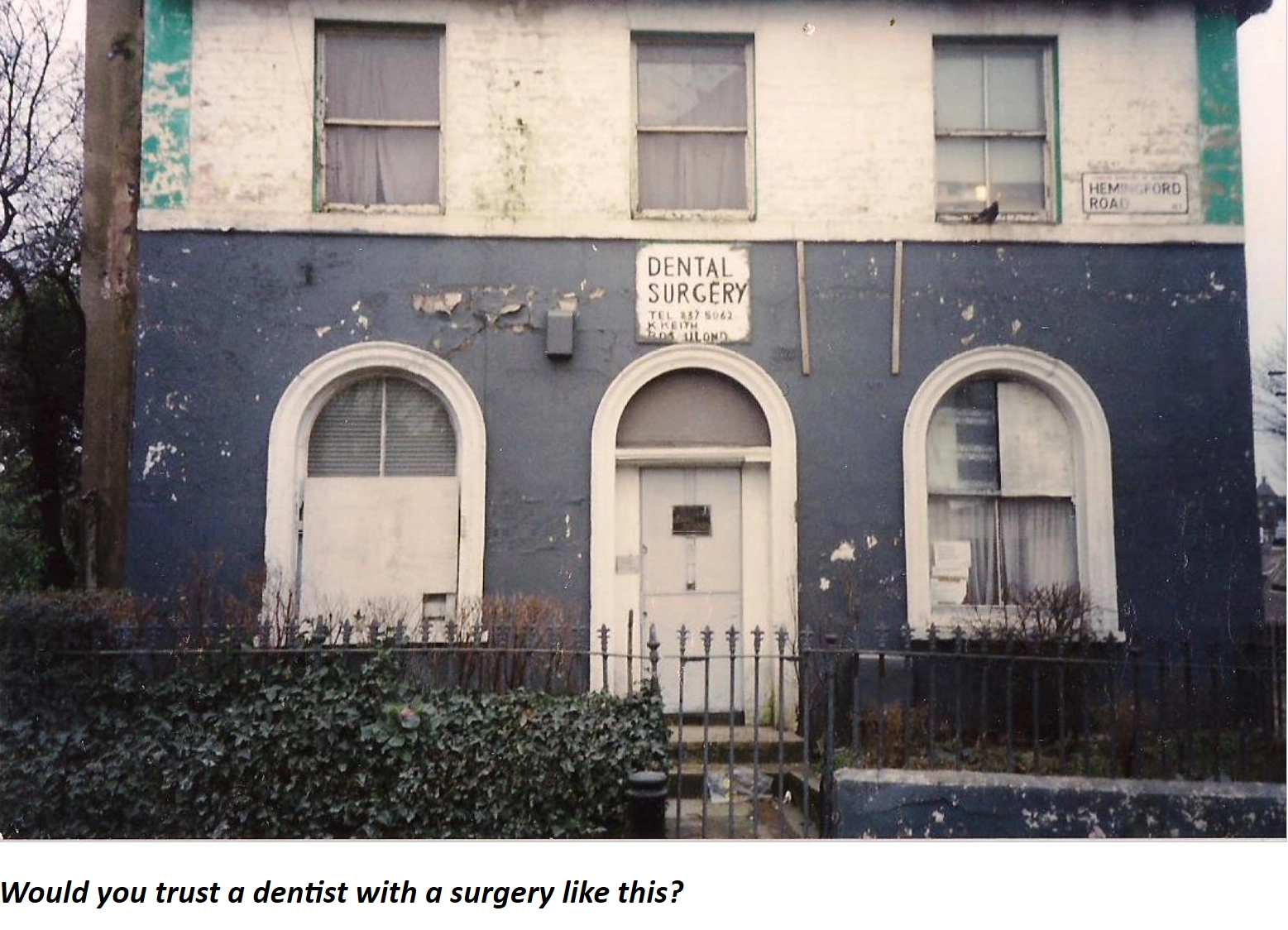
Above all, make sure what you’re selling matches expectations. Consider, for instance, the picture above, which was a snap I took of a Brooks-style un-des res some years ago. Would you trust your teeth to a dentist with a sign and a surgery looking like that?
Make sure the specs are rose-tinted
With property brochures for big developers, chances are that a large chunk of it will be taken up by the specifications. Not just the basics like number and sizes of rooms, but the floorplans, finishes, fixtures and fittings.
That was another thing that Roy Brooks excelled at. Within the tight confines of his classified ads, you’d know at a glance the most important facts, from precise location to numbers of bedrooms and bathrooms (in foul order or not).
By contrast, most property brochures will have page after page of these specs, alongside the glossiest of photos. Even in these repetitive sections it’s worth paying close attention. There may also be a useful feature or fact hidden away which you can use in the main copy.

Who’s the better writer – Roy or Claude?
When it comes to media, Roy Brooks would be astounded. In his day, the most he might aspire to would have been a brochure or upmarket magazine. But given the newspapers eventually used to let him run his classified ads for free, so entertaining were they, he never bothered with anything else.
Nowadays, though, property marketing means websites, articles, white papers, blog posts, videos and social media, alongside old-school print media and glossy giveaways.
There’s something else that Roy Brookes would be astonished by these days, of course, and that’s the AI revolution. The sheer breadth of what’s required may make it tempting to hand over all your property marketing to Claude, ChatGPT or the rest. There are many reasons why that wouldn’t work, however.
In the first place, personal observation matters. AI can’t wander round a property by itself unearthing interesting selling points (or amusing downsides, were you to adopt the Roy Brooks approach).
Nor can AI do half the things a decent property copywriter can. It can’t interview people properly or talk to them face to face. It can’t make sure that all the details are correct, or that your tone of voice is adhered to. Nor is it up to speed on the latest proptech, or how to explain and showcase it for different audiences.
There’s another issue too. That old-fashioned wallpaper from Roy Brooks’ day is still around in one sense – dull, repetitive property marketing. In fact the kinds of phrases that Roy Brooks was subverting are used even more than they were in his day. And given AI is trained on all this, it’s unlikely to come up with anything the least bit original.
So, while AI can do a lot of the donkey work, it’s best to use a real-life property copywriter who can offer originality and creativity. Not to mention accuracy, diligence and empathy. Someone, in other words, with all the necessary marketing strings to their bow. Even if the arrows they shoot are not as wickedly barbed as those of Roy Brooks.
For more on property copywriting, please visit my property copywriting page
If you would like to discuss your next property copywriting project, please contact me









Share this: